
The CEO wanted to kill the product. 3 changes took net margin from break-even to 18%.
Net Margin After Ads — Up From 1.2%
More Profit Per Unit
Conversion Lost to a 20% Price Increase
ACOS — Down From 28%
The Situation
Good product. Good reviews. Good sales. Twenty-nine cents of profit.
A variety-pack snack box launched with a 29% contribution margin before ads — healthy for grocery, right in line with the rest of the catalog. But as a variety pack, it converted at less than half the rate of the brand’s commodity products. More clicks to get a sale meant a $7.00 cost per acquisition against $7.29 of pre-ad profit.
Everything left over: $0.29 per unit.
The CEO’s call was to discontinue it. Reasonable — on paper, this product barely existed.
The Case to Keep It
The launch signals didn’t look like a failed product. Reviews were strong. Sales momentum was real. Customers clearly wanted the thing — the demand wasn’t broken, the margin structure was.
That’s a different problem, and a fixable one. We asked for the chance to engineer the margin before writing the product off.
The Fix: Three Moves, Three P&L Lines
Move 1: Raise the Price — $24.99 → $29.99
- An aggressive move — on a per-ounce basis, more than the brand had ever charged anywhere
- Internal pushback said it would feel like ripping customers off
- But competitor analysis showed rivals already charging more per ounce for variety packs than for their commodity products — customers expect to pay for variety
- Result: +930 bps of contribution margin · ACOS 28% → 23%
Move 2: Shrink the Box — #4 → #2 Carton
- We ordered a sample and opened it: single-serve bags rattling around in a box far bigger than needed
- A smaller carton condensed the dimensions, and Amazon remeasured the product
- Result: FBA fee $6.75 → $5.76 · +330 bps
Move 3: Enroll in SIPP — Ship in the Product’s Own Packaging
- The single-serves had been going into a large bag; a box cost nearly the same and qualified for Amazon’s Ships in Product Packaging program
- Amazon applies a label to our box instead of boxing our box — small move, free money
- Result: another $0.10 per unit · ≈50 bps
The price increase was the bet that mattered — and conversion didn’t drop at all. Same conversion rate, 20% more revenue per order, and ad efficiency improved 500 basis points.
.png)
The Margin Bridge: From $0.29 to $5.63 of Profit Per Unit
Each move stacked on the last. Same product, same demand — a rebuilt P&L underneath it. Price did the heavy lifting, packaging did the fine-tuning, and ad conversion held at 10% the entire way.
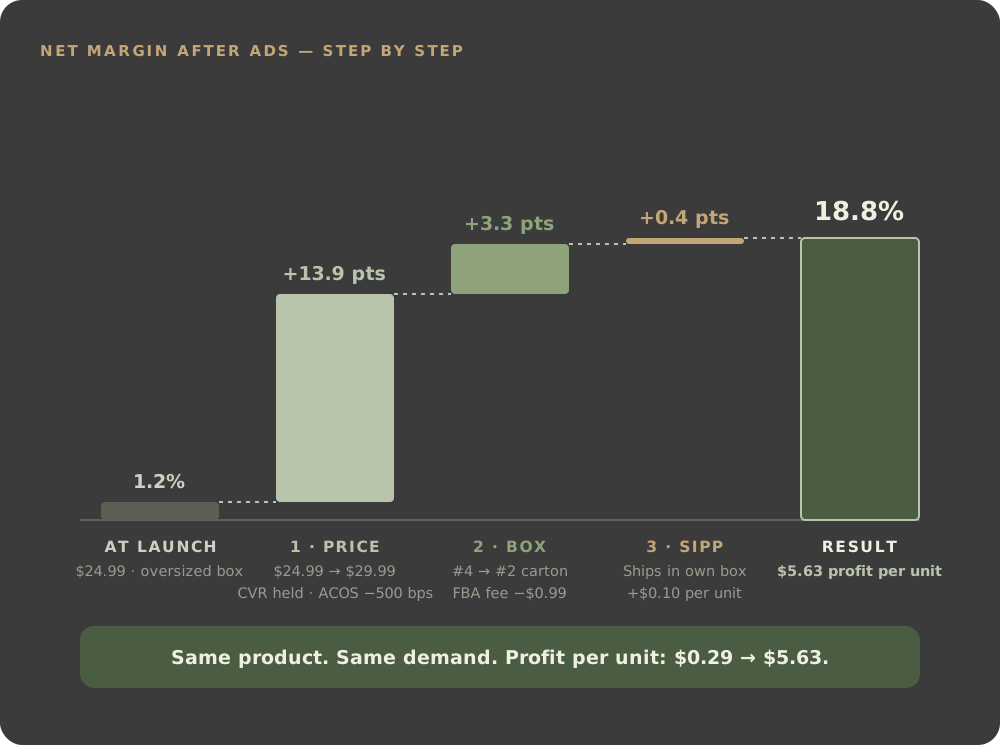
Why it matters: every input the ads depend on stayed put — $0.70 CPC, 10% conversion rate, $7.00 cost per order. Nothing about the marketing changed. The margin was rebuilt entirely underneath the ad: contribution margin climbed from 29.2% to 42.1%, and the same $7.00 cost per order that once consumed the whole profit now leaves $5.63 behind.
.png)
The Results
A product that was 29 cents from the graveyard became an 18.8% net margin product — strong for the grocery category.
- Net margin after ads: 1.2% → 18.8%
- 19× more profit per unit: $0.29 → $5.63
- Zero conversion lost to a 20% price increase — the bet that made it all work
- With the economics fixed, the product could finally be advertised with confidence — it scaled into one of the biggest parts of the account
The Takeaway
A product with real demand and no margin isn’t a failure. It’s unfinished.
Margin is engineered, not discovered. Price architecture, packaging dimensions, and fee programs are all levers — and most of them never show up in an advertising dashboard. Before killing a product with momentum, it’s worth asking whether the P&L problem is actually a design problem. This one was, three times over.
Contact us
Ready to transform your Amazon account? Reach out today, and let's start crafting your success story together.